Thursday, November 24, 2011

East Java highlights

29.-31.10.: Probolinggo and Ceromo Lawang

The train ride to Probollinggo from Banyuwangi took 7 hours, and we saw a lot of pretty countryside pass by. It would probably have been nice to spend a few days there, but this region is an empty, white speck in Footprints Southeast Asia. The food we packed before getting onto the train - mystery rice from the same people we drank coffee with, before - was an unnecessary precaution, because the train was regularly visited by hawkers, whose prices generally aren't above the usual street level, and who pack a variety of interesting snacks, which should cost no more than Rp3000 a bag. The hawkers navigated the already full train. It seems school's out by 12 here, as there were a lot of school girls I'd put into medium to late secondary school, age wise.

In Probolinggo, 7pm is too late for bemos, and we took a becak (bicycle rickshaw, Rp15k for the both of us, haggle hard) to get to a hotel 3km from the station, Hotel Ratna. Rp100k got us a room with fan, shower, western toilet with its toilet seat (the absence of which usually makes "western toilets" in Indonesia more unhygienic and uncomfortable than the local crouching mandis), TV (one program, Indonesian) and breakfast (kopi, almost raw toast with butter and badly made jam, hard boiled egg and a fork and soup spoon that was too large for the egg, no knife. I guess the thought counts, but I usually prefer Nasi Goreng for breakfast here, they can handle that).

Met a couple of Indonesians and two Saudis at a public viewing of the Arsenal-Chelsea game that evening, and ended up having a drink with the Indonesians. Coffee, of course, as everyone here but a small smattering around old Hindu holy places is Muslim. Their English was far better than my bahasa indonesia, so we could talk about a fairly diverse range of topics, but once again, as with Rica and Waia, the fact that Germany only has one language with dialects was a difficult concept. Indonesia has at least a dozen more common ones.

The next day we caught a bemo to the bus station of Probolinggo, a place known for inflating it's prices and the thieves on busses frequented by tourists. We wanted to get to Cemoro Lawang, a village at the edge of a giant volcanic crater turned plain in which a couple of volcanoes stand around, including the famous Gunung Bromo, a Hindu holy place (Cemoro Lawang is populated almost entirely by Hindus).

We arrived at the station around 9:30am, let us be guided into a bemo, our backpacks put on top, for the price of Rp25k. Then we waited. An waited. After half an hour, another passenger, Indonesian. Then the driver shoes us into the bus. Joy! We're finally leaving! Alas, it was a false alarm: For a reason I cannot fathom, the driver wanted us on board for picking up another tourist from a hotel a whopping 500m away, then turned around and drove back to the station. Waiting again. Met a German family (kids grown up) who had met up for Java with their daughter and her British boyfriend, who had been traveling Indonesia for two months. They also wanted to go to Cemoro Lawang, thus filling up the bus nicely, but wanted a price of Rp15k, which the driver was unwilling to give. After dithering and insisting forever, they told him they'd pay Rp25k only if he did not stop along the way to pick up passengers, effectively chartering the bus. Otherwise, they said, they'd only pay Rp20k a person. Thanks to that, we left only around 12 o'clock, although the crowd of locals that suddenly appeared out of nowhere may have meat there was enough people all along, or that the bus only goes at 12. On leaving, we had around 17 people aboard a Mitsubishi Colt, a minivan the size of a VW bus. Of course, the driver stopped, which was commented with a contented "Jetzt gibt's nur noch 20." from the Germans. The muttered "Das macht er extra!" (That's on purpose) when the bus stopped to fill up petrol was a little bit over the top though. The ride itself took 1.5hours, past hillsides continuously terraced not with rice, but with onions and cabbages.

Booked the cheapest place we could find, a 3-bed, two bedroom building with a sitting room up front, and an external bathroom, for Rp80k, a definite rise. No service, of course, but for some reason it was cheaper than single rooms, external bathroom, belonging to the same person.

Just afterwards we met two Germans, Vic and Hendrik, who had come up with the next bus (for Rp25k, must be the correct price) and just had booked another place to stay. Too late to move in with us, but we nevertheless set a date for the evening meal at the warung next to our place - right at the start of the right hand of the only branching of roads in Cemoro Lawang, when going up - the food's good.

To see the sun rise over the volcanic valley (not over Gunung Bromo itself, that point lies far afield) you get up at 3:30 to 4am, depending on your walking speed, and head up the road, ever along, past two gaggles of coffee- and snacks stands, and countless offers of ojek- and horse rides, until you reach a third group of stands, which signifies the second (and definitely better) lookout point

After the sunrise (partly hidden by clouds, but the part where the sun beams hit Bromo was pretty neat, with our coffee in our hands), we headed further up the hill - quite a climb, don't try this in thongs - and started walking around the edge of the crater, which also happened to be the ridge of a string of mountains on this side (while Cemoro Lawang lies on a plateau that falls off into the great crater). Sometimes, we even had enough of a path so we could walk instead of climb! Lots of fun, and pretty sights in both directions, into the crater and to the fertile and densely populated plain on the other, northern side. Just when the view started t get boring, we found a road heading down into the crater, and took it, passing another slew of buses and jeeps ferrying tourists back, doubtless from other sunrise-viewpoints.

After a brunch at the warung next door, we took the 12 o'clock bus down to Probolinggo, with Vic and Hendrik. Down there, we got bus tickets for a night bus to Solo (Surakarta), a big hassle, with shopping around, and bargaining hard, we got a price of Rp80k instead of Rp120k, but, unlike we were told, no a/c. The bus did drop us off at the hotel, though, a nice touch. Vic and Hendrik went east, practically skipping Bali for Lombok, Flores and so on. Since the night bus would go at 8, we started looking for supper around the terminal, where basic meals cost Rp15k - the reputation for gouging travelers is well deserved, it seems, because we got the same kind of meal for Rp5k about 500m down the road, at a tiny warung with friendly people, where the 7 year old daughter enlisted Doro for her English homework. The baby always started crying when I tried to play with her, though.

A post about Solo's next, whenever I can get it finished. No p[ics this time, although I've got them here, but this pc is infested

Monday, November 14, 2011

To Java, East, from Bali

The last post ended on Oktober 27th, on Ubud, Bali, just before we left for Java. We had the presence of mind to ask what the price for the bemos is we would need to get to Gilimanuk, where the ferry crosses to Banyuwangi on Java, and the driver, maybe because he's one of the few honest ones, maybe because he couln't profit from us directly, told us the real price: Bemo Ubud to Batubulan and Bemo Batubulan to Ubung Rp. 10 000 each. From Ubung, a bus goes to Gilimanuk for Rp25k. This may be a good strategy to find out the real price of transport, but we have heard tourist prices even then.


On the 28th, a Thursday, I believe (ups, a Friday. Rest of post edited and dates corrected), we then went to the bemo terminal of Ubud, and were offered Rp150k directly to Ubung, or R80k to Batubulan. Great. We insisted for a long time, but in the end had to pay Rp30k for the both of us to Batubulan, and then the driver didn't even get us all the way, but foisted us off on another bemo somewhere in the middle. There we luckily met Ayu, a local girl going to Gilimanuk to meet up with a friend of hers, who took us under her wings. The travel from there on went well, with Ayu interceding for us whenever the price was not right, both with the drivers and the hawkers coming onto the bus to sell food - mostly fried tofu with hot peppers and soy sauce, or peanuts boiled in salt water. The bus to Gilimanuk got pretty crowded, and it was not comfortable at all travelling with our backpacks in the way all the time, often on our laps, but the countryside, which started to exist in western Bali (as opposed to the settlements everywhere in central), was pretty. No a/c, so it got hot again, but all windows and doors were kept open all the time -- try to sit right behind a door in such a bus. There seems to be no inappropriate time to smoke in Indonesia (also no inappropriate age, today we saw a vendor selling cigs to 12 year olds), so people will smoke next to you on the bus. This is not so much of a problem because of the air circulating through the windows.

We got to Gilimanuk late in the afternoon, said our farewells to Ayu, and crossed the street to the ferry harbour, where the prices for crossing are listed, Rp6000, no haggling, thankfully. The crossing itself was uneventful, apart from Made, who talked to us in broken English. It seems his name means "second son" in Bahasa Bali, or alternately "sixth son", or "tenth son", as there are four names that go through cycles: Putu, Made, Nyoman, Ketut.

In Banyuwangi, a tour agent told us the way to a cheap hotel "700m" (closer to 1.5km) away, where we got a room with bathroom for Rp40k - in fact, this is the cheapest room we've had (up to now, Nov 14th!), and certainly one of the best. Yay for not being in a tourist-frequented region. Settled in, went out for a walk, and immediately were invited by Rika, who was on her way to pick up her son, to visit her home, where we spent the evening trying to communicate with her and later her neighbor, Waia. Apart from the language inadequacies, it was rather tiring because both largely insisted on talking to me through Doro : "And your Boyfriend, what is his name?", ".. what will he do?" and so on. Still, they tried to teach us some bahasa indonesia, and we reciprocated with inggris and jerman.

Later that evening we dined at a local Warung, where no one spoke an English word. The meal involved a lot of smiling at each other, and us stammering out the few sentences of Indonesian we had just written down, with mixed success: We only understood answers that could be communicated by "yes", "no" or signs.

On the 29th, Saturday, we hiked to the train station (stasiun kareta api), allegedly 3km from the hotel, in truth right past the ferry harbour. There, we noticed that, somehow, all clocks in Banyuwangi seem to be an hour late. This, of course, meant we had passed into another time zone from Bali to Java, which our guidebook neglects to mention... Luckily, the direction of time change meant we were two hours early instead of one, so we proceeded to have breakfast and drink coffee with the group of people sitting around a mobile stand in front of the train station, comunicating much the same as the day before. 

At least good coffee is available everywhere in Indonesia. A word of caution on Indonesian drinks (minuman) though: everything will be sweetened, unless you specifically request otherwise. Ordering kopi or  kopi susu will get you sweetened black or white (the "susu") coffee, the powder still in the glass, and our first fruit juice on Bali, the mango one, included a gratitious amount of chocolate syrup, though sugar syrup is more common for drinks. We were told to order Kopi tawa (English 'w') if we wanted it unsweetened, but in Central Java, this just confuses the poeple, and a translation site just gave me kopi hitam or kopi pahit. I'll try that next time.

Well, that's all for now, in my ongoing effort to juggle being on an interesting country where I'm trying to get up with the sun (6am is our best mark, yet) and writing about it. Time is short, as you can see: I'm writing this from Pekalongan, on the north coast of Central Java. Still a lot to catch up...

All the best from here!

Friday, November 4, 2011

Culture

25.-27.10.: Ubud

On Tuesday, we took an early shuttle bus by Perama (10am) to Ubud, another tourist paradise, albeit a qquieter one, known for its artists (including European expatriates) and unspoilt (by tourists) countryside. The wait was made nicer by free tea, coffee and wi-fi in the nice, open-walled waiting room.

The bus itself was not airconditioned, so the trip was hot and sticky. Baggage was simply thrown up front between driver and door. The trip itself was short enough, 2h.

In Ubud, we were immediately surrounded by people trying to get us into their hotels, offering rooms from Rp150k. The speed with which they accepted our demand for Rp100k told us we were still paying too much, but accommodation was infinitely better than in the Rempen: We chose Petri Inn, right next to the Perama station, with a spacious room, bathroom with shower and squatting toilet (flush by ladle from sink), a small porch with a table and wicker chairs, and breakfast (banana pancakes with honey and some pieces of banana, papaya and pineapple on the side, everything covered with coconut flakes). The people there were friendly; the owner and cook introduces herself as Ibu, which means "mother" in Balinese and Baha Indonesia.


By 1pm, we had settled in and were walking along the streets of Ubud, in no particular direction. In the city center, we found a man selling a dish of rice, tofu, soy bean sprouts and hot peanut sauce (gato-gato, but slightly a different recipe, Rp 5k), and coconut juice (with ice, some sugar syrup, and a piece of lime, delicious, Rp 3k).

We headed up the street the vendor was in, venturing into small paths going off; the houses were surrounded by elaborately decorated walls, with statues of demons (gods?) at the entries, so the whole quarter looked full of temples - only the washing lines in front of the mundane houses further back told us that people lived here (ordinary people, too, no priests, as far as we could tell. Schoolkids came home while we were there, and the grown-ups passing us seemed mundane). We also found narrow stairs down a deep gorge to a lonely temple in a rainforest-river setting.Walked out of the center, along the sparser houses, although central and southern Bali are never really uninhabited. Even if you find a road not lined, city to city, with houses, in the rice paddies the buildings are seldom more than 50m apart. Along the way we bought cooled water (1.5l for Rp4k) at one of the small shops/stalls owned by non-english speakers, which is only slightly more expensive than in the supermarket (generally, supermarkets are even more expensive for most goods in these, poorer, countries than markets or street vendors, or even hawkers in trains and buses). Each rice paddy has a shrine, almost all houses more elaborate ones, sometimes with multiple statues and small buildings, and every so often there is a fully fledged temple, with crazy statues and decorations galore. Bali is architecturally extremely interesting.

Back to the inn by 5pm, after a quick stop to get chow along the road - rice with green vegetables (beans, chili, onions) and soy sauce for D, mine had fish, egg and pressed soy beans added, for Rp5k and 8k.

Wednesday: To market, mostly touristy stalls full of batik clothes, watches, jewellery (local and international styles), and wood- and ivory carvings. Some fruit and food stalls, got a delicious meal with some kind of dark, sweet(ened?) rice.

Coconut at Goa Gajah. That's the life.

The "Elephant"


Walked 5km, more or less, to Goa Gajah , the Elephant Cave, were some obviously benighted person mistook a quite human demon face around the entrance for an elephant. The temple precinct is quite expansive, lots of pathways through the rainforest. A ten minute walk to a temple ruin in a river down a gorge is especially worthwhile.

The walk to and from Goa Gajah was interesting for the views of Bali we got, but not particularly pleasant, the traffic being heavy on the road not designed for pedestrians.

Thief!
Thursday: Found good coffee and mango juice at a Warung on the way to the market (3k and 8k, respectively. Fruit juices get a lot cheaper off Bali). Visited the Sacred Monkey Forest, a small forest overrun with makaques being fed by visitors. There also are 3 temples there, with multi-day ceremonies going on right now, but tourists are barred from the temple grounds during prayer times. Nice setting, though, and watching the makaques was good fun (entry Rp20k).With their beards, they look quite human. Being used to us means they will jump at bags that contain food, and we saw several instances of water bottles being stolen. Often, they don't know how to use them, but every so often, you see a monkey that can drink in a human way. We ourselves lost a mango we just had bought from the market to a monkey while debating, in front of the forest, if we should enter with our fruits despite the warnings...

Saturday, October 29, 2011

Kuta, Bali

I'm kinda behind on the posts, but I want to write about something recent, so I'll skip New Zealand and Australia for now, and get back to those later. I also cannot connect my SD card to the pc here, so I'll hopefully load some pics sometime else.
23.-24.10.: Denpasar & Kuta

Sunday: Flight to Denpasar, through visa and customs, taxi to Kuta, the tourist village of Bali, for Rp80 000 (~$9) after a lot of haggling. Still got stiffed, we probably could have gotten a ride for less than Rp40 000.The first taxi driver to talk us up (he eventually passed us along to someone cheaper, he wanted $20) told us: "Germans don't like Kuta. Too busy. Germans want to see real Bali. Australians go to Kuta, for the discotheque."

Kuta is a mass (mess?) of touristy stalls along mostly small pathways, many only a span wide, all shared by scotters and pedestrians going in both directions. Te density of taxi drivers (including motorbike taxis) and massage 'spas' is incredible. The amount of ugly or downright stupid t-shirts obviously sold to drunks is amazing.

The weather in Bali is hot and humid, so that your clothes will stick to you. In cheaper hotels, air conditioning will generally double the price of a room, bu a fan over the bed is usually enough to make the night comfortable. We were pointed o a hotel named Rempen as cheap and got a room for Rp 100 000 (~Euro8.50), but we cannot recommend the place: to filthy.

From there, we walked along the streets of Kuta during the remainder of the day and the next. We ate at stalls a bit off the main tourist roads, the meals including fried banana with coconut and chocolate flakes covered in evaporated milk, gato-gato (rice with vegetables in a peanut sauce, often very spicy) and chicken curry (Rp 5k, 12k and 15k, respectively). The range of places to eat is varied, with street vendors starting at Rp 5k for vegetarian, rice-based meals, up to restaurants only slightly cheaper than in Germany.

Traffic is fluid, rules relaxed. People tend to drive on the left side, but at the slightest opening in traffic a gaggle of scooters -- they make up about 80% of traffic, unlike in Bolivia, where Buses and Taxis dominate -- will overtake slower trucks, and 50m of free space will induce your bus driver to overtake 5 scooters and two trucks. Pedestrians, of course, are far down the food chain, pedestrian crossings drawn on the street only to get rid of excess paint, I surmise. Still, it works, and the upside of this kind of driving is the relaxedness with which people get through traffic. Honking is used a a friendly, fair warning to others that you're there and need that space, unless you are a herd of tourists on motorbikes, who honked continuously because traffic generally does not allow more than 30kph, at best 40, and the mean Balinese would not clear the road for them. (Other, slightly off-topic pet peeve: I don't care how bad their English is, calling the waitress at the friendly, and cheap, restaurant [Warung]  Missy is downright arrogant)

On a final note, in Bali you can expect to find someone around who speaks English reasonably well, so communicating is not a problem. This must be different outside of the island, and we're grateful that we have the time to get used to Indonesia.

Bali is a Hindu island, and this is a very visible religion here. I'll write more on that in the next post, but there are some nice pictures from Kuta I want to share. Basically, in front of every house, you find these little prayer bowls made of banana leaves and filled with flowers and foodstuff: rice, soy sauce, crackers, chocolate... You smell incense every couple of steps. This is quite nice, the smells of the city are drowned out, and the open air (I can't say fresh, in Kuta) dissipates the incense fast enough so it does not become overbearing.


There's shrines everywhere. Many houses come as little complexes, with a shrine region in front, and I guess one larger families houses in the back. Note the demon on the right hand side of the shrine in the picture to the right.
The picture below, shows a housing complex. The roofs are all shrines, and somewhere in there a house is hidden. If the area's too crowded for such a complex, the house at least gets a small stele, as seen down below.

Sorry for the crappy formatting, but I'll not spend my time around here trying to get it right :)


Friday, October 14, 2011

USA

29.06.-28.08.: USA

The end of june, we arrived in the US from Bogotá. The trip brought on our only stay at a midrange hotel yet, the Ft Laudedale Holiday Inn, courtesy of the inability of our airline to be even remotely on time.

Here are a couple of highlights:
-Brooklin Chinatown, which puts the touristy made up Chinatown on Manhattan to shame ( which still beats, and slowly takes over, Little Italy, a couple of roads full of expensive Italian restaurants), where stores and their wares are often labelled only in chinese.
- a spontaneous looking music circle, with lots of drums, some flutes in northern Central Park, near Harlem. 30 or 40 people where there, some dancing, including the one white woman in a colourful dress.
- the people I passing me on a coffee run in Pittsburgh around 6am, all of whom greeted me, as if P were a small village.
- our two week stay in Uniontown, where Doro's guest brother Smo got married, and we slid down the Ohio Pile until our butts were too sore. Thanks, Rockwells!
- a relaxed week at Sandy Lake, always a favorite, and spending some time with Levi and Zach, although I only got to see Lucy once. Thanks, Andrewses!
- a game night in Columbus. If we can ever get the Mainzians together for games again, I'll have some new ones. Also, we were introduced to the Bookman series. Thanks, Nellies!
- St. Louis at night, during our three night trip by Greyhound to the Yellowstone. Our longest brake was in Salt Lake City, 6h, which is also the first place the ticket attendants could actually tell us that it is possible to get there by bus.
- the last night of that trip, where we were driven to Rexburg, ID, bus station, then back to Idaho Falls, then back to Rexburg at the American Inn, where the bus was supposed to come in the morning, and we were allowed to crash in the lobby, with coffee and hot chocolate. Arrival at 2am instead of half past 11.
- hiking the national parks: the impressive Yellowstone, with its immense geysers, colorful hot pools, lake, elks and its unholy alliance of deer flies and mosquitos (all of which we saw, in the latter case in the form of constant clouds around us, everywhere, always; taking a piss was not fun in that forest); and with its undeservedly much more famous, and elusive, grizzlies, wolves, bison and moose, who kept away from us. The majestic Grand Canyon, with its manylayered red rock formations, birds soaring along the cliffs and over our heads, the capricorn along the vertical incline, its immense heat - 50° C, at the bottom, in the only hypothetically existing shade, at noon, with rocks black as mafic rocks can be; we got down and back again in one day, not one of our easiest hikes) and blissfully bug free. The beautiful Yosemite, full of views - if you're ready to climb the steep and long paths - brown bears, marmots, mountain creeks, redwood trees and glacier lakes in the Californian August.

May Lake, Yosemite Park. Here Doro had a chipmunk
stretch before her eyes.

- the park rangers, ranging (haha! ) from Yellowstones friendly helpers - "Don't worry, no one will care if your 7 days entry pass expires. Just stay a couple of days longer" - to Grand Canyons rule freaks ( "It matters to the RULES" - he had me get out of the empty bus to put on my shirt, which I had given to the freezing Doro, and gave that answer when I asked why it matters where I put it on).
- those friendly people who let us hitch a ride with them: the couple from Long Island who took us into the Yellowstone; Saf, the Indian working in Silicone Valley, who took us out again during his first roadtrip through the USA - staying away from the Canadian border, because the police there can demand his immigration papers; Lynn, oil rig manager, on his way home from North Dakota to Ogden, Utaw, who took us there after the telephone assistant from the bus company told us the bus had left West Yellowstone 2h early, since most people book their seats and no one had done so - we did not because our discover passs don't demand it; Turell and his family, Navajos, who were the only ones to stop for us after 4h on the quite well travelled highway to the Grand Canyon, and afterwards invited us to dinner in one of the posh restaurants at canyons edge; and finally Janet, who took us back to Flagstaff from Tusayan, and noted the demise of hitchhiking culture in the US.
- the ritzy Strip of Las Vegas with its flashy shows, and the imitation in Reno, falling far short, but way more friendly because of that, where a motel attendant told us to look for a room at the Sands, which costs as much as the motel during the week. We enjoyed getting up at one am to go down and loose a couple of dollars, though Doro managed to win 4 the first night. Also, longdinks for $1.50.
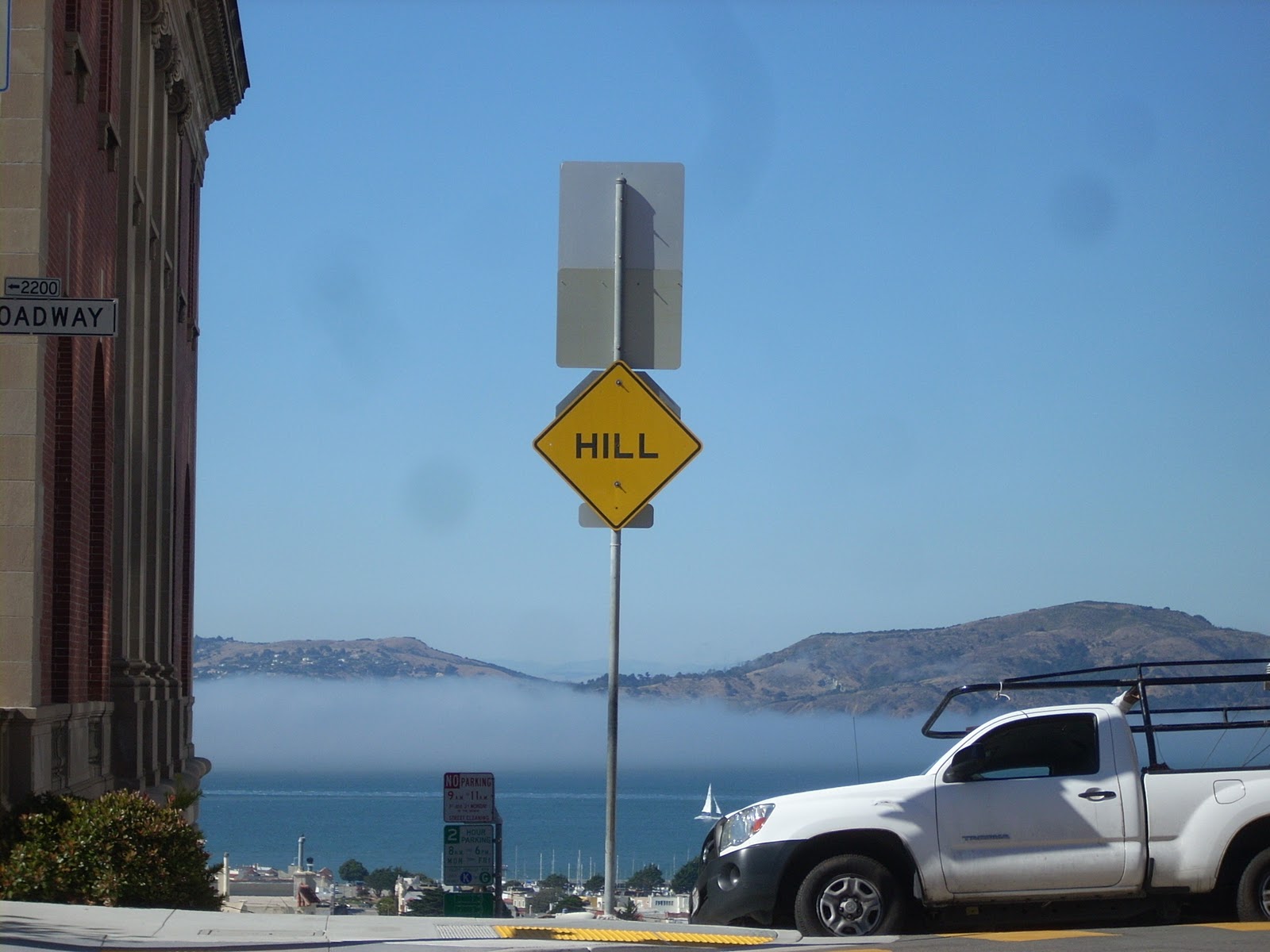
- the fortress-like mansions along the strait but steep streets of San Franciso; also the only Japantown I've seen yet, and the only town so far we weren't able to find a place to sleep (for less than $100) upon arrival - although Sydney came close a couple of days ago. Right around the corner of the Greyhound station is the favoite sleeping place for bums.


Indeed a hill in San Francisco. Please note the angle
of the car parked there.

- in LA, we stayed at a place alternatively described as hostel-hotel (the online ad by Howard, the owner) or as halfway house (the neighbors). 4 tiny rooms crammed with 2 bunkbeds each, two baths and a kitchen. Six to seven permanent tenants, who have to put up with tourists every high season, for the price of only $360 a month... the owner, whom we never saw, is big on cash, so as not having to pay the booking fee incurred by placing his house on hostelworld, and seems to befriend anyone on facebook for free advertisement. The people living there are some of the most interesting we have met, including an Austrian, whose business was screwed over by his wife while he was in hospital after a tank ran over his car, who is in LA so he can keep more of his invalid pension than the €900 a month allowed by his bankruptcy, a Georgian (USA) cook and self-styled redneck trying to get into comedy shows, and a hispanic admirer of bad old Adolph H ("at least", his argument went, "he stood by his pinciples and his people to the end". I tried pointing out a couple of holes both in that logic and the statement, to no avail. I think he wants someone to stand up and gather the hispanics into as close knit a community as he imagines the jews and arabs to be.). We also met a frenchman there who had, for the last 4 years, had cycled through the Sahara desert (into Ethiopia) and to Southeast Asia, and having just arrived in LA from there, set off to buy a bike and ride it to New York, in 80 days. He'll fly from NY to Lisbõa, to cycle to Paris, in order to complete his trip around the world.

Saturday, August 20, 2011

Piep

Just a quick message to you all to tell you that we're still alive and well. We've been in national parks for most of the time, and otherwise when you're travelling internet is hard to come by at reasonable rates unless you have a wifi device (free wifi everywhere, internet for $24 an hour), which we don't. South America was easier by far in that respect.

I'll be writing more on our travels as soon as I get some fitting device from a used electronics store or some such. San Francisco is my big hope at the moment.

Hope you're all well, on both sides of the Great Puddle.

PS: Yes, our time out West was great, so far.

Tuesday, June 28, 2011

Rayna Inti

22-24.06.: Otavalo

 Lodging: El Geranio, Rocafuerte y Colón, more or less. $10 a room, private bath only because the key to the room without private bath could not be found. Nice place, friendly people, headquarters of a volunteering project, where people pay to teach kids for 2 months. The money goes to stipends for rural kids, so that they can visit the better urban schools. The project just started, so the place is teeming with Americans getting their introductory Spanish lessons. They keep mostly to themselves, though.

The room is interesting: it is (or was, at the time we got there) clean, and comfortable, but a damaged water pipe in the ceiling must have been left to leak for so long that mushrooms grow on the ceiling. No, not mold.

Otavalo is famous for its artesanias market, which is supposed to cover half the city on weekends. During the week, it only fills the Plaza del Ponchos. The selection of clothes, blankets, carpets, jewellery and peculiar stuff like bone knives or small figurines is diverse, much better than in all other places we've visited.

This week, there is the mostly indigenous festival (or collection thereof) known as Los San Juanes, or less catholic, as Rayna Inti (I think). By accident, we met a fellow German, Markus, who also wanted to see the festivities. On Wednesday, the 3 of us went to Peguche, a village right outside of Otavalo. There, from 9 to 12 in the evening, there was music, dancing and a chicken exchange -- a local tradition, also done with fruit; anyone can take as much as he needs, but must give back double the amount the next year.

Luckily for us, we met Mauricio, who lives in Peguche, at the festival. He was wearing a self made mask with two faces, took us in, gave us free booze (there were some people, including us, walking around with half-liter glasses of liquor), and explained some of the rituals to us. (Also luckily, Markus just had come from 6 months of volunteering with KulturWeit in Nicaragua, and speaks passable Spanish, so he could translate.) The music was lively, mostly idigenous sounding stuff, but also some fiddles which reminded me distinctly of colonial American music.

Around 11, Mauricio led us onwards to a waterfall in Peguche, where people have a spiritual (but quite materially cold, let me assure you) bath around midnight. We watched while Mauri and Markus bathed in the ice-cold water (Markus: "I wouldn't be doing this if I weren't so drunk" -- most men and women there weren't drunk, not being such wusses as we are). We then escorted the drunken Markus and the freezing Mauri back to take a cab home.

Thursday we slept in, and had a quiet day, but I ate lots of delicious food from the stalls on the street, especially those set up for the festival. In the evening, the Plaza del Ponchos was filled with people watching dancing groups in costumes and traditional garb. To the music they themselves played -- always the men, by the way, we never once saw a women carrying an instrument -- they danced the same circular polonaise we saw the day before. The only exceptions were a dance troupe performing in front of a raised dais with what I guess were the local magnates. We watched for a couple of hours, again drinking local varieties of liquor -- though far less than the day before. Even though there were quite some stands selling drinks, and we saw people buying them by the bottle (pints of liquor, mind, not beer), the only drunken people we met where a Canadian and an Italian.

Friday:
We waited for the hostel's family to start partying, which didn't happen, so we went back to the Plaza del Ponchos, where the party seemed to be ending. We nevertheless spent a delightful evening drinking beer and watching the rest of the festivities slowly die away with Moritz, a German from jena who had just spent a couple of weeks in Colombia after finishing two trimesters of physics on exchange in Caracas, with whom we of course exchanged travelling tips and stories.